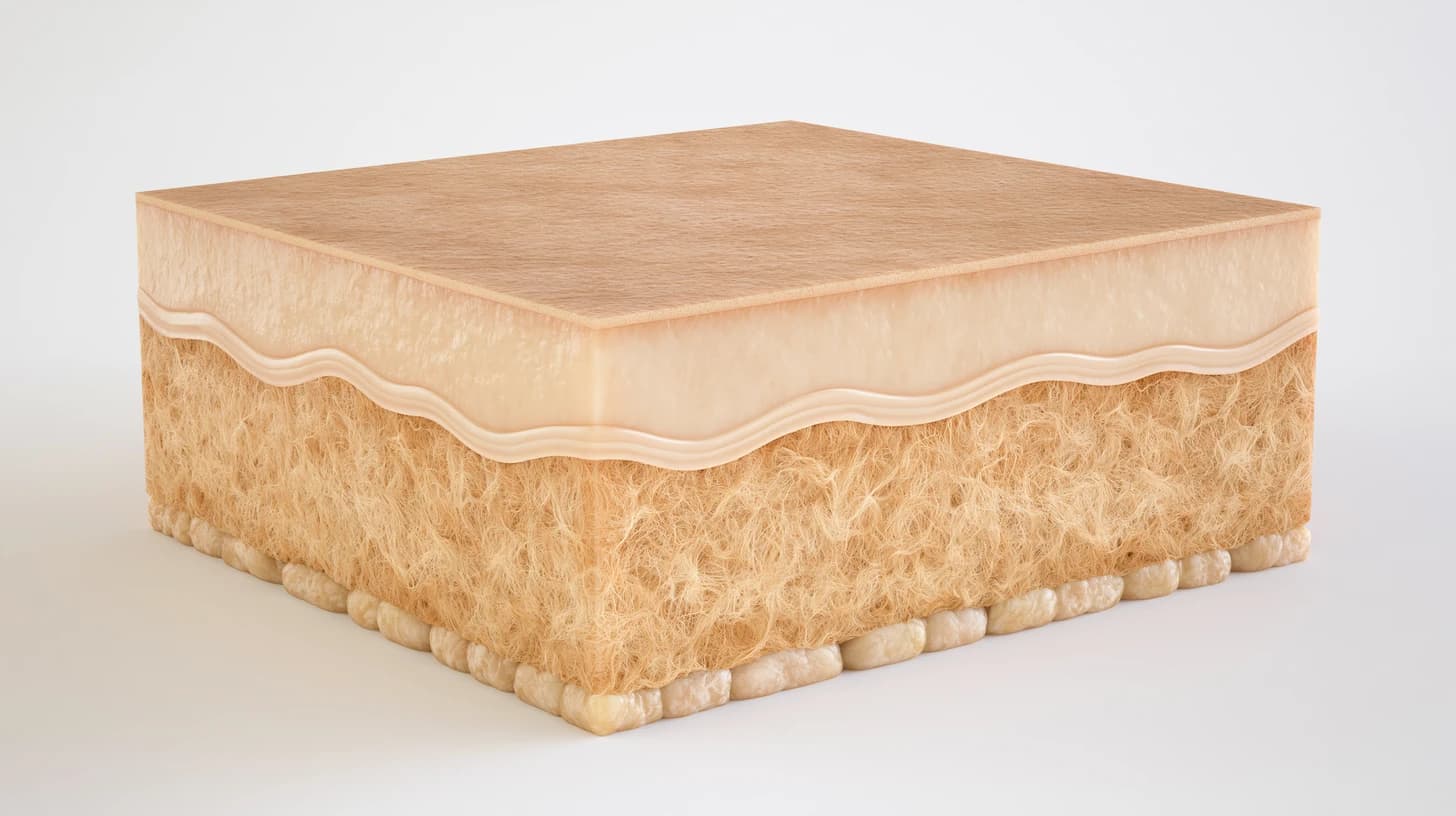
Radiofrequency and ultrasound skin tightening differ less in strength than in how they deliver heat. Monopolar RF warms a broad volume of tissue, from the dermis into the fibrous septa of the subcutaneous layer. Focused ultrasound (HIFU) places small points of heat at a set depth — as deep as the SMAS, at about 4.5 mm. Which one fits depends on the layer your doctor finds is behind the laxity.
Neither radiofrequency nor ultrasound is the better skin-tightening treatment in general. In Korea both are usually listed as "lifting" treatments, but what they actually do is tighten: heat contracts existing collagen and prompts the skin to build more over the following weeks to months. What differs is where that heat goes, and in what shape.
Radiofrequency (RF) heats tissue through its electrical resistance, warming a broad volume from the dermis down into the fibrous septa beneath it. Focused ultrasound concentrates acoustic energy into small points at a chosen depth — 1.5, 3.0 or 4.5 mm — the deepest of which reaches the superficial musculoaponeurotic system (SMAS), the layer a surgeon tightens in a facelift. Not every ultrasound device works this way: Sofwave, covered below, heats a single layer of the mid-dermis instead.
Neither replaces a surgical facelift, and which one suits you can only be decided after an in-person assessment.
How Does Radiofrequency Skin Tightening Work?
Radiofrequency (RF) energy turns into heat as it meets the electrical resistance of tissue. That heat does two things: existing collagen fibers contract right away, and a wound-healing response builds new collagen over the following 2–3 months.
A monopolar RF device heats in bulk rather than in points. XERF, the device used at COCO Clinic, runs two frequencies: 6.78 MHz concentrates heat in the dermis and along the fibrous septa, while 2 MHz travels deeper, into the subcutaneous layer. The aim is overall firmness and skin texture across a broad area.
A session takes about 40–60 minutes. Downtime is minimal: there may be temporary redness or swelling, and most people return to daily life the same day. XERF is given in units of 300 shots. The guideline is 600 per session; 300 can be enough for younger skin with little laxity, and a wide area from forehead to neck may take up to 900.
How Does Ultrasound Skin Tightening Work?
Focused ultrasound concentrates acoustic energy at a focal point beneath the surface, creating small points of heat at that depth while leaving the layers above largely unaffected. High-intensity focused ultrasound (HIFU) devices use cartridges set to 1.5, 3.0 or 4.5 mm. The deepest reaches the SMAS, the fibrous layer a surgeon tightens in a facelift. COCO Clinic's HIFU device is LinearZ, which lays those points down in lines rather than single dots.
Not every ultrasound device is focused. Sofwave sends seven parallel beams, with cooling at the skin surface, to heat a single band of the mid-dermis at about 1.5 mm. It does not reach the fat layer or the SMAS. It is aimed at skin thickness, elasticity and fine lines.
LinearZ takes about 10–20 minutes and Sofwave 30–45 minutes, including numbing cream. Redness usually settles the same day. With Sofwave, visible change begins around 4–6 weeks and peaks at about 3 months.
How Do RF and Ultrasound Compare on Depth, Timing and Longevity?
The three devices used at COCO Clinic, side by side.
| XERF (monopolar RF) | LinearZ (HIFU) | Sofwave (parallel-beam ultrasound) | |
|---|---|---|---|
| Shape of the heat | A broad volume | Small points, laid down in lines | A single band |
| Depth | Dermis into the subcutaneous layer | 1.5, 3.0 or 4.5 mm cartridges, down to the SMAS | Mid-dermis, about 1.5 mm |
| Session | 40–60 min | 10–20 min | 30–45 min |
| When change shows | Some firmness right away, then builds over 2–3 months | Some tightening right away, then builds over 2–3 months | Begins around 4–6 weeks, peaks at about 3 months |
| How long one session lasts | About 6–12 months | About 3–6 months | Varies widely; we do not give a fixed figure |
| Afterwards | Temporary redness or swelling; daily life the same day | Redness usually settles the same day | Redness and warmth usually settle the same day |
These are the figures we work with at the clinic, not guarantees. How long a result lasts depends on age, skin condition, and habits such as sun exposure and smoking.
What Can't RF or Ultrasound Skin Tightening Do?
Neither can reposition tissue the way a surgical facelift does. Both work by prompting collagen to remodel, which is gradual and varies with age, skin condition, and habits such as sun exposure and smoking. With significant sagging, energy-based treatment alone may bring limited change, and your doctor should tell you so before treatment, not after.
Side effects are usually mild but not absent. Temporary redness, warmth and slight swelling are common with all three devices and tend to settle within hours to a few days. Tenderness or small bruises happen occasionally. Rare effects differ by device: a surface burn or blister with RF or Sofwave, and with focused ultrasound, temporary numbness or tingling along a nerve, which generally recovers within weeks. Focused ultrasound at 4.5 mm can also reduce some of the fat beneath the skin — welcome along a full jawline, unwelcome in a face that is already lean.
These treatments are not given during pregnancy or over active infection or inflammation. Tell your doctor about a pacemaker or other implanted device, metal implants in the area, a tendency to form keloids, and any filler or botulinum toxin in the past two weeks.
Some discomfort is possible with any of them. XERF is mostly felt as warmth. LinearZ gives a brief, sharp heat as each line passes. Sofwave is done with numbing cream, which is available for the others on request.
Which Questions Should You Bring to a Consultation?
These points are for framing questions, not for self-diagnosis. The decision follows an in-person examination.
- Overall firmness and skin texture across the face. Ask about RF (XERF). It heats the full thickness of the skin rather than one chosen depth.
- A heavy lower face — jawline or under the chin — where the fat layer is thick. Ask about focused ultrasound (LinearZ), which can target the SMAS at 4.5 mm.
- Skin that has grown thin and finely lined, or a lean face where you would rather not heat the fat layer. Ask about Sofwave, which stays in the mid-dermis.
The three are not rivals. Because they do different jobs, they are often planned together.
How Does COCO Clinic Use RF and Ultrasound?
COCO Clinic is near Cheonho Station in Gangdong-gu, Seoul. We use three energy devices — XERF (RF), LinearZ (focused ultrasound) and Sofwave (parallel-beam ultrasound) — because no single one covers every layer. With all three on hand, the plan can follow the face rather than the machine.
XERF is the device we have used most. In February 2026 its manufacturer, Cynosure Lutronic, named the clinic an official XERF Heavy User, a designation for clinics that performed more than 30 XERF treatments a month throughout 2025.
Before any treatment, skin condition, elasticity and the thickness of the fat layer are assessed in a one-to-one consultation, and energy levels and shot placement are set for each person. Results are not guaranteed, and plans differ from one patient to the next.
When Should You Schedule Treatment Before an Event?
One to two months ahead is the usual reference point. Most of the change arrives as collagen builds over the following weeks, so one to two weeks ahead is usually too tight. Sofwave peaks at about three months, so go a little earlier if you can.
If you are traveling to Seoul, all three allow a return to daily life the same day and fit a short stay. Two things are worth raising before you book. You will probably be home before the result shows, so an in-person follow-up may not be possible. And LinearZ is usually started as about three sessions, 2–3 months apart, which a single trip cannot cover.
This article is general information, not a recommendation for any individual. Whether a treatment suits you is decided at an in-person examination.
Frequently Asked Questions
Which is better for skin tightening, RF or HIFU?
Neither is better in general. RF such as XERF heats the full thickness of the skin in a broad volume, for overall firmness and texture. Focused ultrasound (HIFU) places points of heat at a set depth, as deep as the SMAS at 4.5 mm. Which one fits depends on the layer your doctor finds is behind the laxity, and the two are often planned together.
How long do RF and ultrasound skin tightening take to work, and how long do they last?
Some firmness is often felt right away, but most of the change builds over 2–3 months with XERF and LinearZ. Sofwave begins around 4–6 weeks and peaks at about 3 months. At our clinic one XERF session lasts about 6–12 months and LinearZ about 3–6 months, while Sofwave varies too widely to give a figure. None of these is a guarantee.
Is Sofwave the same as HIFU?
No. Both use ultrasound, but HIFU focuses energy into points at depths down to 4.5 mm, while Sofwave sends seven parallel beams that heat a single band of the mid-dermis at about 1.5 mm. Sofwave does not reach the fat layer or the SMAS.
Can RF or ultrasound skin tightening replace a facelift?
No. Neither can reposition tissue the way surgery does. Both prompt collagen to remodel, which is gradual and varies between people, and with significant sagging the change may be limited.
When should I schedule skin tightening before an important event?
One to two months ahead is the usual reference point, because most of the change arrives as collagen builds. One to two weeks ahead is usually too tight. With Sofwave, go a little earlier if you can.